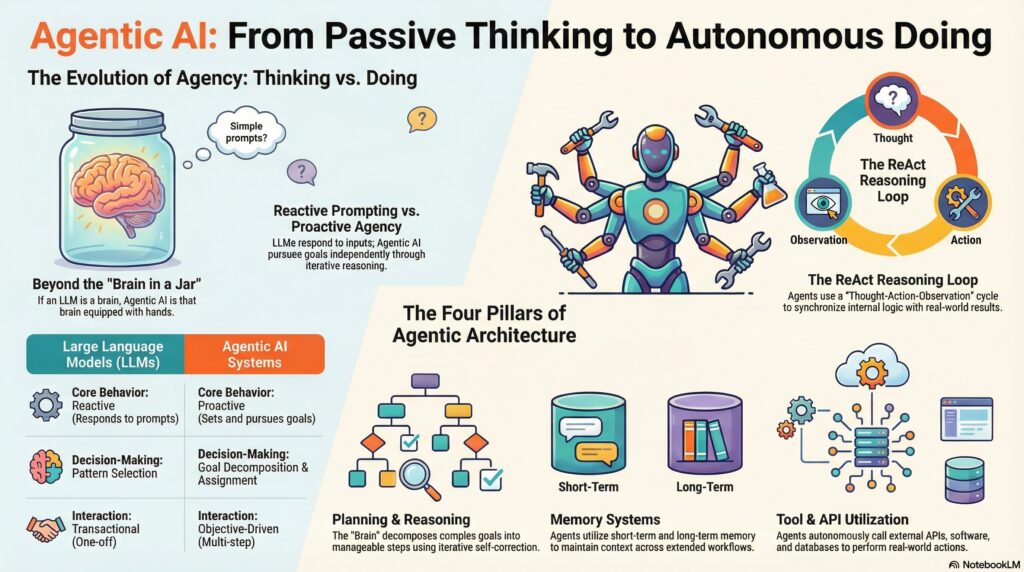
Agentic AI represents a fundamental evolution in technology, marking the transition from passive, reactive models to autonomous, goal-oriented systems. This shift moves the industry from mere “knowledge generation” toward “result generation.”
1. Core Definition
Unlike traditional Generative AI, which remains reactive and waits for a prompt to generate content, Agentic AI is proactive. These systems are designed to act with autonomy, mimicking human-like decision-making processes. An agentic system can pursue complex goals, reason through challenges, plan specific steps, and execute actions in both digital and real-world environments with minimal human intervention.
2. Key Characteristics
For a system to be considered “Agentic,” it typically functions as a combination of a “brain” (the LLM) and a “body” (the tools). This synergy requires four core capabilities:
- Autonomy & Decision-Making: The ability to make independent choices to solve complex problems and adapt to environmental changes without constant supervision.
- Reasoning & Planning: The capacity to break down a high-level goal (e.g., “coordinate a product launch”) into manageable sub-tasks, evaluate progress, and self-correct if a strategy fails.
- Tool Use: Beyond generating text, these systems interact with external APIs, databases, and software. They can send emails, execute code, query inventories, or manage transactions.
- Memory & Adaptation: The use of short-term and long-term memory to maintain context across interactions and learn from past experiences to improve future performance.
3. Generative AI vs. Agentic AI
The primary distinction lies in the difference between thinking and doing:
| Feature | Generative AI (LLMs) | Agentic AI |
| Role | Linguistic Engines | “Bold Doers” |
| Nature | Passive thinkers; they understand and generate content. | Active operators; they understand intent and act upon it. |
| Execution | Limited to outputting information. | Utilizes reasoning to trigger external operations. |
4. Agents vs. Agentic Systems
A deeper technical distinction exists within this paradigm:
- AI Agents: Modular entities typically designed for specific, narrow tasks (e.g., a bot dedicated to managing customer returns).
- Agentic AI: A broader paradigm shift toward multi-agent collaboration. In these systems, multiple specialized agents coordinate, negotiate, and collaborate to achieve high-level objectives that exceed the capacity of a single agent.
In essence, Agentic AI is the technology that enables machines to move beyond telling us things to doing things for us, functioning as an autonomous digital workforce capable of reasoning, planning, and execution.