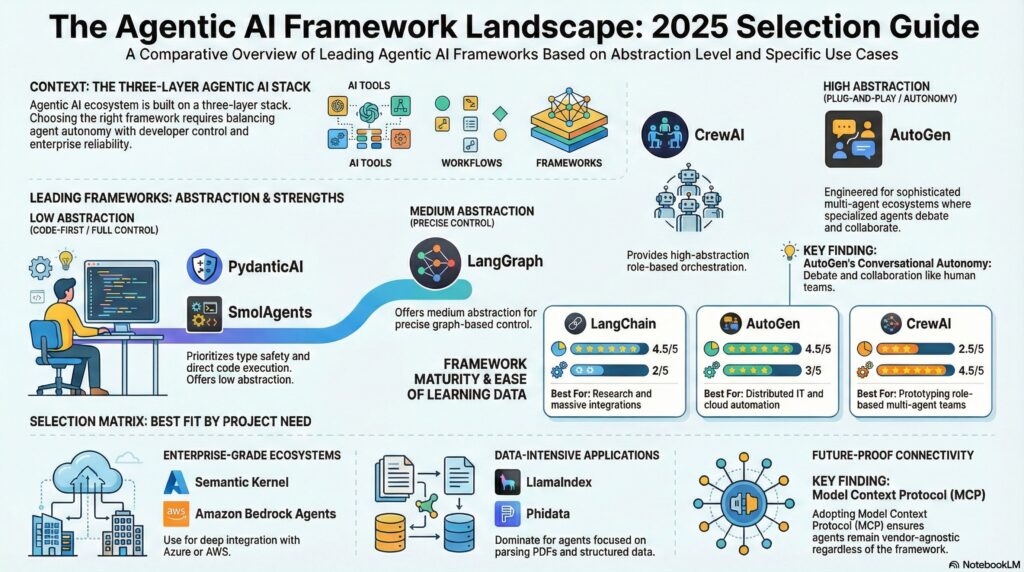
Building autonomous systems requires more than just a powerful LLM; it requires an orchestration layer that manages state, tools, and collaboration. Based on current technical documentation, the ecosystem is divided into specific categories optimized for different levels of abstraction and control.
1. General Purpose Orchestration: The “Heavyweights”
These frameworks are the most mature, designed to bridge the gap between reasoning models and business logic.
| Framework | Key Strengths | Best Use Cases |
| LangChain | Massive ecosystem with 1000+ integrations (DBs, APIs, Models). | Research, rapid prototyping, and diverse API integrations. |
| LangGraph | Cycle and State Control. Allows for persistent memory and loops. | Enterprise production and complex “human-in-the-loop” workflows. |
| Semantic Kernel | Microsoft native. Deep integration with C#, Python, and Java with enterprise security. | Corporate environments and legacy app integration within the Azure stack. |
2. Multi-Agent Collaboration Frameworks
Designed to coordinate specialized agents working as a cohesive team.
- AutoGen (Microsoft): Focuses on conversational and asynchronous task resolution. It excels in code generation and autonomous software development through agent debate.
- CrewAI: A high-level, role-based abstraction. You define a “crew” with specific backstories and goals, making it ideal for sequential creative tasks like marketing or research.
- Swarm (OpenAI): An educational, lightweight framework focused on the “handoff” pattern between agents. Perfect for lean proofs-of-concept.
3. Data and Code-Centric Frameworks
Optimized for technical precision, data integrity, and type safety.
- LlamaIndex Agents: Specialized in Data Orchestration (RAG). It is the premier choice for indexing and retrieving information from complex private document sets (PDFs, Excel).
- PydanticAI: A “code-first” framework that rejects “magic” abstractions. It uses Python’s native type system to ensure agent outputs perfectly match API expectations, ensuring production reliability.
- Smolagents (Hugging Face): Radical simplicity. Agents solve tasks by writing and executing Python scripts directly rather than processing complex text strings.
4. Managed Enterprise Platforms
For organizations prioritizing governance and infrastructure abstraction over custom code:
- Google Vertex AI Agent Builder: Integrated governance for those already within the Google Cloud/BigQuery ecosystem.
- Amazon Bedrock Agents: Native AWS integration handling scaling, security, and observability out of the box.
- Microsoft Copilot Studio: A low-code approach that democratizes agent creation for non-technical teams.
Summary: Which one to choose?
- Startups & Rapid Prototypes: CrewAI or Smolagents.
- Robust Production Engineering: LangGraph or PydanticAI.
- Data-Intensive Workflows (Legal/Finance): LlamaIndex.
- Microsoft/Azure Ecosystem: Semantic Kernel or AutoGen.
- Pure Research & Exploration: LangChain.
A note on Interoperability: The industry is rapidly moving toward standards like the Model Context Protocol (MCP). Think of it as the “USB-C” for AI, allowing any agent to connect to any tool regardless of the underlying framework, significantly reducing vendor lock-in.