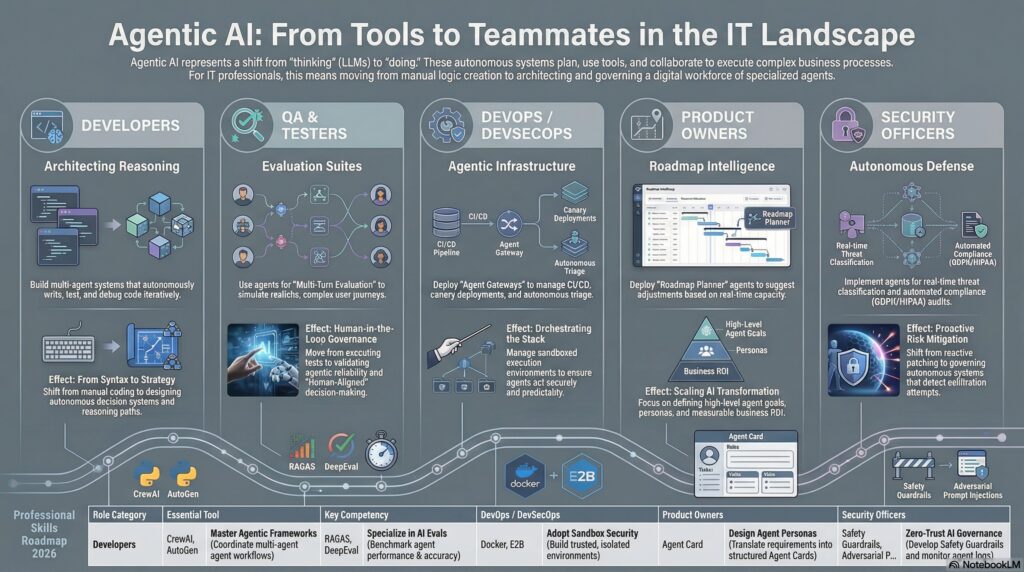
Agentic AI is redefining professional roles by moving the focus from “doing” to “supervising”. As autonomous systems take over repetitive tasks, tech professionals must evolve into architects and auditors of digital intelligence.
1. QA and Testing: From Bug Hunting to Quality Strategy
- The Use Case: Agents can now generate test cases from documentation, execute suites, analyze error logs, and even propose code fixes independently.
- Role Impact: Testing evolves from manual script execution to designing high-level quality strategies for autonomous systems. Testers will focus on auditing agent decisions and identifying complex “edge cases” that AI might miss.
- How to Adapt: Master Agent Evals using tools like LangSmith to ensure agents reason correctly. Learn to build “guardrails” to prevent hallucinations or critical failures in production.
2. DevOps & DevSecOps: The Rise of AgentOps
- The Use Case: Predictive maintenance agents monitor server logs in real-time. If a failure is detected, they can diagnose the root cause, restart services, or rollback a deployment without human intervention.
- Role Impact: The role shifts toward AgentOps. You will manage the entire lifecycle of agents: deployment, cost monitoring, and “health” (preventing infinite loops).
- How to Adapt: Familiarize yourself with sandboxing platforms (like Docker or E2B) to execute agent code safely. Implement observability to trace why an agent made a specific decision.
3. Developers: Transitioning to Agent Architects
- The Use Case: Coding agents can now take a Jira ticket, navigate a repository, plan a solution, write the code, and open a Pull Request ready for review.
- Role Impact: Developers become AI Systems Architects. Less time will be spent on “boilerplate” code, and more on designing multi-agent systems and defining how tools (APIs) interact.
- How to Adapt: Master the Model Context Protocol (MCP), the emerging standard for connecting AI to external data. Learn orchestration frameworks like LangGraph or CrewAI to build specialized assistants.
4. Product Owners: Data-Driven Goal Setting
- The Use Case: Roadmap planning agents analyze thousands of user feedback entries and support tickets to suggest backlog priorities and predict KPI impacts.
- Role Impact: POs gain massive data analysis capabilities, allowing them to simulate scenarios before committing resources. The challenge shifts to defining precise objectives so agents do not deviate from the business vision.
- How to Adapt: Focus on defining success metrics and business strategies through advanced prompting. Understand ethical and security limitations to avoid approving risky AI-proposed features.
5. Security Officers (CISO/SecOps): Proactive AI Defense
- The Use Case: Cybersecurity agents work 24/7 to detect complex attack patterns, automatically isolating compromised devices and patching vulnerabilities in real-time.
- Role Impact: The role moves from reactive to proactive. The main challenge becomes AI Governance—protecting against new vectors like “Prompt Injection” and ensuring agents do not have excessive permissions.
- How to Adapt: Specialize in AI Security and Red Teaming (attacking your own agents to find flaws). Apply “Zero-Trust” architectures to all autonomous agent interactions.